
Few notes about Amory Stern’s Introduction at Poe’s Metzengerstein and Berenice
A few starting words
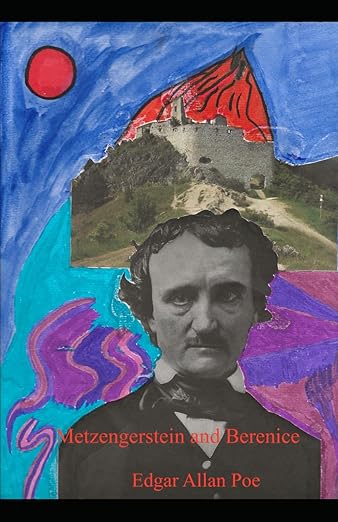
A very special intellectual and artist, Amory Stern, made me the honor to receive one of his latest works: a new print of the two earliest Edgar Allan Poe’s stories, Metzengerstein and Berenice. The opus was made in 20242, but it was printed, as shown on the last page, on 09 October 2025, Middletown, DE, USA.
In the beginning of these sixty pages there is the Editor’s Introduction: Poe’s Early Horror Stories and the History of Gothic Fiction (of course, signed by the named Amory Stern)3. This twenty page text starts with a very well and traditional placing of the two stories in Poe’s opera and life, in the Gothic genre… And from here we are gifted by the editor with a very particular approach.
Slowly from the term Gothic we are introduced to the forefathers of it: “the enigmatic ancient people” known (?) as Goths.
I used the “?” as the author of the Introduction… will not just use the word “enigmatic”, but it will highlight some of the Goths’ enigma that still stirs a lot of debate in the West Europe, USA or other parts of the world.
The spot on the Goths is skillfully connected not just with the genre of the named Poe’s stories, but with the place of Metzengerstein’s action, too: “the Danubian region, where the Goths roamed in late Roman times” (op. cit., p. 6).
Amory Stern’s presentation was an invitation and incitement for me, as a historian. The Goths are part of my special interest in Romanian History – the beginning of the Romanians.
I must say first that Amory Stern is one of the very few Western intellectuals I found to know what they are talking about Danubian region’s history. As both he is always looking for local sources that are mainly unknown – and even despised – by Western Europe. And he’s writing sine ira et studio, something that values more than the whole gold in the Universe.
Still, I hope that I can give a small contribution on his Introduction… by the notes I felt could be useful for some points. Points that were passed to briefly, for a person interested in details of that era – and people – as myself.
As parenthesis, I will say that the observations further given are based on today known archaeological and historical sources; if there will be new findings, that will change the knowledge on that issues, the notes can become obsolete. Is a risk always present in any discipline4.
So, for those interested in a little more intricate views on some topics, I wrote the following notes.
Note 1 Where Goths a branch of Northern Thracians known as Getae?
Amory Stern does not give a definite answer at this question. Still, his quote of Frederic Guillaume Bergmann shows a tendency to give credit to Jordanes’ claim (that Goths were Getae).
We think that there are some very interesting nuances of the original – Jordanes’ – claim. Nuances that can bring some light on the issue.
First of all, the term itself, belagines. We can use here the works on many authors, from Lehmann to Bennett, but a short approach seems more fit here: the word belagines is not a Gothic word, as it can’t be find in any other old Gothic text. Even in the Wulfila’s Bible, where is should necessary be – if it was a Gothic word. Still, Jordanes is using is at such, a fact that proves it was known in that time as the name of the Thracian laws that Jordanes sees as Gothic.
Second, the Gothic language is obviously Germanic, but Germanic words are hardly find in any of North Thracian (Getic, Dacian) lexicon. Is very clear that both Gothic, a centum language, and Thracian, a satem language5, were Indo-European languages, but not the same language, not even close ones.
Third, seems very clear that Jordanes knew the languages difference, but could not care less about it. This attitude is not unique in the Roman world Antiquity or Middle Ages, but not even today is missing. In today’s Greece, for example, the law does not care about the maternal language of the citizens: all are seen as Greeks, even if the maternal language is Romanian, Albanian, Turkish, Bulgarian etc. In today Switzerland the personal and cantonal language is important at some level, but without any change in nationality: Swiss. The Roman Empire was ruled in the second half of third century (A.D.) by emperors of thraco-illirian heritage – some, as Gallerius, known for the barbarian use of Latin. After that, and mainly form 602 further, Roman Empire will have Greek as main language of the ruling class. The Greek will call themselves Romaioi, to claim to be the new Romans; the state was called Romania or The Empire of Romans; the Christian-Latin heritage was claim to be theirs, and they claim to be the direct heirs of the Christian Roman Antiquity.
For all this – and other secondary reasons – there is in Romanian Orthodox historiography the view of Goths as the only ethnic group ever that received the North Thracian laws (belagines) becoming with this process part of the Thracian world.
In this view, Jordanes is 100% right in claiming the Goths were Getae; not as language, seen as of a minor importance in this matter, but in spirituality, the only important critter for ethnicity.
I would mention here that is the same view about the Church and Israel in New Testament, and from here the same view about ethnicity of the Church until the split between Papacy and Church in latter times6. As Jordanes was part of this culture – of the first seven Christian centuries – is something worth remembering.
Note 2 Some brief mentioning about the confluences on Germanic and Thracian populations and culture(s)
Just as a taste for the readers, and maybe a starting point for some researcher, I thought that some mention about a few know cases of confluence between the Germanic and Thracic worlds.
I wrote known cases, but this could be an overstatement. The cases that follows are mainly well-known in some archaeological and historical research circles in Romania. For the readers outside of this country the cases can be either hundred percent new, or from some very political bent presentation. As always in this pages, we will stay on facts, away of the unnecessary and unsavory political implications of any interpretations.
As such, we will mention the fact that Northern Thracians had deep and long time contacts with a lot of ethnic groups – many times both (the contacts and the groups) neglected in historical presentations. The connection with Baltic Sea, for example, is well-known just through amber and some other commercial exchanges (always briefly noted if at all).
Scythians and their special heirs, Sarmatians, have a presence of about two and a half millennia in today Romania. They settle in Dicia or south-eastern today Romania, in the Romanian Plain (a.k.a. Getic Plain or Danube Plain), in south and far north of Moldavia, in center of Transylvania, in the western parts of Dacia, in Pannonia etc.
A Bronze Age tumular culture, in some points even present in the Hallstatt age, was spread in the far north of Moldavia and Maramureș7. There are two aspects that we think deserve our attention here: the lack of luxury and the cultural amalgamation.
First aspect is important as shows it was a culture of the many, not of the few – fact that is supported by the frequency of findings.
Second, as the objects of this tumular culture are of Thracian, Germanic and Celtic influence or origin. This had lead to many debates. Is this culture a Thracian one, with Germanic and Celtic influences? Is this a Celtic culture with Thracian and Germanic influences? Or we have here a Germanic one with Thracian and Germanic influences?
Noteworthy is that the area of this tumular culture is the attested area – in written sources – for Northern Thracians known as Costoboces. And I will state again: all the now known historical sources of Antiquity and early Middle Ages present Costoboces as Northern Thracians. This should be enough to give light on the matter, and help us with a deep understanding of the fact that the named Costoboces are the first Thracians known to work and fight together with Goths.
When the Costoboces are lost from the historical sources we can’t find any reason for it. They have had not been butchered by Romans, massacred by Scythians or (other) Germans. They just fight together with Goths for a century. After that, their name just vanish from history.
Some other Northern Thracians, the Carps, that lived in Central Moldavia (from Carpathians until the east of Dniester River), will took the place as Goths’ allies. The process is simultaneous with the southern advance of Goths in the old Dacia.
When Goths moved south of Danube (and from there in the western parts of Europe and north-western parts of Africa), the Carps vanish too, in the same way as Costoboces earlier.
The presumption of a Thracian-Germanic synthesis, in which the Costoboces and Carps integrated in Gothic structures and Goths took (a part of) Dacian (Getae) heritage seems, in the view of this facts, a very reasonable one.
From the year 275 A.D. the Roman Empire had a treaty with Goths that marked the Goths as foederati (confederate subjects of Roman law). It was the year in which Gothia was born, as a Roman client state, that took over the greatest area of North Thracian Roman provinces.
The relation between the Roman client state of Gothia and Roman Empire was not a linear one: there were peace and collaborations times and there were war times.
Unhappy with Gothia involvement in Roman Empire – and mainly with pagan Gothic kings persecution of Christians – Constantine the Great took over the southern of Gothia. And it will revive for a while some north-Danube Dacian provinces. After a while, the greatest part of this territory will be again integrated in Gothia.
Gothia will have just a little over a century life: around 390 the Huns will make Gothic ruling and warrior class migrate in Roman Empire and the state Gothia become history.
Still, the name Gothia was the alternate name of the region together with Dacia even in the Middle or Modern Ages.
Two villages in the Romanian north-Danube have (today), a very special position.
We are talking about Ocland (in old times, Acland or Akland) in Transylvania, Oclanda on the Dniester River (today in Moldavia Republic, made-off by Moscow from ripping-off Romania).
The first one, Ocland, was the subject of my personal research in the past.
Very different from the other Germanic places in Transylvania, it has no year of settlement. And it must be mentioned that the other Germanic places in the Transylvania have the year of settlement, as are part of Hungary’s efforts to displace the Romanian population – efforts that starts as a mission for Papacy in 13th century and had become an (extremist) ethnic goal from 18th century until today.
Moreover, Ocland was in the beginning of 19th century a Romanian speaking place, a unique reality as there was no other only German named village in Transylvania8.
As such, the local Romanian folklore, that claims Ocland to be “the last Gothic village”, seems to have great chances to be true.
For Oclanda we can mention that there is no settlement year too, in any historical sources we could access.
Both villages are in the area that both Goths and Roman client Gothia have been.
We must emphasis on the fact that what we put in front of our reader are just some historical and ethnological facts – and a few credible hypotheses. We will not pretend that these facts are absolute proofs for Jordanes’ claims. Still, any light on the matter is better than none, and we believe that may ideas that historian take as truth have much less support. As such, is very well possible that Jordanes is right in this matter.
Note 3 About the political values of Getic identity of Goths
Amory Stern is approaching the political potential or values of Jordanes’ claims in a very synthetic way. For example, in Introduction… p. 7-8 he mention the special position between Barbarians that the Thracian identity brings to Jordanes’ Goths. Of course, and excursive approach in this matter would have been just a digression for Stern’s work. Still, we think that some readers can be interested by some facts that can open some very interesting knowledge doors.
We will start with something that can be seen as a truism: in the Jordanes’ time the Roman Empire was alive and well. This is a fact that many western scholars – and, with them, theirs readers – tend or likes to forget (if they ever knew it). But is a very important truth, because any understanding of Jordan’s positions starts from here. From the reality that he was a part of the Romania (Terra Romanorum), writing as a Roman in a Roman world.
So, Jordan’s work and his claims about Goths must be put in the proper context.
First, it should be mentioned that Emperor Justinian the Great is the one that had liberated the Italy, including Rome, from Germanic domination. And this was just a part of the conflicts between Germanic barbarians and Romans. Conflicts that in the said times already were almost a tradition – even if the synthesis between Germans and Romans was already very advanced.
Second, Emperor Justinian comes from a Roman family from Macedonia – and a Roman family with Thracian roots (or Thraco-Illirian roots). It will be enough to remember the despise he received from Greek language adepts in Constantinople, or the work he put in defending the Latin use in Constantinople, even in the Codex Justinianus – the founding code of modern national and international Law for almost every country on Earth.
Third, Thracians have been an important part of Roman root mythology. Eneas, the Thracian prince from Troy, is one of the legendary ancestors of Rome. And is a very important part of the Roman spiritual heritage. Some Thracian forces were very important in Roman fight against Greek invasion of Italy, and in the takeover of Epir or other Greek controlled states.9
Fourth, for the ancient sources it was a well known fact in that time that a big part of Dacians or Gets – the same North Thracians under different names10 – were supporters of Romania (Roman World). The 19th century have seen the rising of the legend of the opposition between Dacians and Romans. Still, the Dacians nobles were as close to the Roman nobles as possible. And Dacia was a client state of SPQR11 before Decebalus – the Dacian and Roman king of client kingdom of Dacia that starts the wars with Roman Empire under Emperor Trajan. Under the mythology of good barbarian the 19th century historiography will build patriot pretense for Decebalus uprising against Rome. There was no evidence to support it, but until know a great number of pages was written about the “heroic resistance” of Decebalus and Dacians against the Roman. Even if the named Romans have never been a threat to Decebalus or his kingdom. Even if they had been very good allies to the Dacian kingdom. Even if, in fact, the Decebalus himself started the wars by plundering incursion in the Thraco-Roman territories of Moesia! And, very important, even if in the two great wars against Decebalus the Trojan Emperor have had the support of more Dacians than Decebalus!
Here we will note that the Dacians from the Upper and Inferior Moesia, from Scythia Minor (today, Dobrogea12), Pannonia, the kingdom of Iazyg Sarmatians13 etc. all fought against Decebalus, supporting Trojan without fault.
Moreover, an important part of the Dacian nobles under Decebalus were opposing his adventure against Romans. They even give a discrete or open support to Roman forces. That’s why after the end of the war – and after Dacia was included in Roman state – the name Dacian was honored in the Roman Empire and were made a lot of the statues of Dacian nobles or theirs warriors that fought alongside with Roman legions. A fact ignored in 19th century, when the romanticized versions of “Decebalus and Trojan wars” were made. And still ignored by a great deal of the now days romanticized versions of the same events.
In short, the Thracian were in the fifth and sixth century AD part of the Roman culture and heritage. They were not barbarians per se, as much as an exotic part of the Roman world.
As such, the so-called confusion between Gets and Goths in Jordanes’ work can be easily seen as a way to defend the Gothic people in front of the Emperor and his people: the implicit claim was that Goths are Gets, ergo Thracians/Dacians, ergo a part of the Roman world, culture and traditions.
But is that all?
How could such a claim have any value in that time?
Now the reader can see why we start this note with the truism of Jordanes living in Roman Empire: because his work was for the people that knew both the Thracian heritage and the Roman world.
In our days Jordanes work is a piece of history. In his days it was a very actual work – like a today political study of a very active nation.
So, how could Jordanes pretend the Goths were Getae without becoming the target of ridicule?
Here we will come back to the fact that Goths were a Germanic population. We have Ulfila’s Bible that is very clear: Gothic idiom was very different from all we know about Thracian idioms. Both were Indo-European, of course, but very different indeed. And is not just about language! The Germanic origin of Gothic people was very well-known.
Still, Jordanes work was well accepted in his time.
And this means that beyond what we think we know, there was something about his claim that made it credible, or even normal.
How was it possible?
The fact that someone was well-versed in Latin, Greek or Persian was not a sign that he/she was Latin, Greek or Persian. And was not a sign that he or she was an/a supporter of Latin, Greek or Persian culture, ethnicity and so one. For example, many supporters of Roman culture, rulership, state(s) etc. were well-versed in Greek. In sixth century Armenia, many Armenian nationalist were well-versed in Persian. Many Greeks that fought against Rome were well-versed in Latin. Etc. Moreover, there were Thracians that were very kin on supporting either Greek or Latin world, Goths that served heroically in Roman Army and so on. And the Roman Empire becomes after The Great Slavic Invasion (602 AD) a Greek language state, even if the Greek population was so minor that the Greek language users called themselves Rhomaioi = Romans of Greek language.
This is a point in which the Western prejudices usually make the understanding of reality impossible.
I met a lot of Western people that in this point were overwhelmed and could not process the ideas.
An old propaganda made Roman Empire to be changed in a so-called “Byzantine Empire” starting with some years aleatory chosen by some western propagandists. Some of them are using year 325, others 330, others 395 etc. This differences have just one origin: there NEVER had been and “Byzantine Empire”!
The pejorative term “Byzantine Empire” was coined late in XVI (sixteen) century as a mean to deceive the readers to deny the continuity of Roman Empire after a chosen emperor (Constantine the Great, Theodosius the Great, Justinian the Great etc.).
If, for example, someone could travel in time and go on the streets of Constantinople in sixth or eight or fourteen century, he will find no one having the slightest idea about a “Byzantine Empire”. Even in the times of Greek language administration of the Empire, the official names, used in all the documents, were Romania or Roman Empire or Empire of Romans.
That Greek speaking people, even using Greek form generation to generation, were thinking themselves to be Romans seems absurd for the great majority of readers. Still, is a fact. And the main reason for such a fact is that the ethnicity or nationality is spiritual in the first place. Everything else is secondary.
For example, George Pomutz was Romanian by birth, religion, language. Still, he is a great American hero – no matter if you are for or against his political views. The same is true for many Americans, but not only. There are a lot of Hungarians that are from Romanian origin, a lot of Italians of German origin and so on.
As such, can be easier to understand the existence of the Rhomaioi or Greek speaking Romans.
And, in this view, can be easier to understand that Goths could have been seen as Gothic speaking Thracians, or specifically as Gets. Both by Jordanes and his readers.
An important mention here is about belagines, the Getic laws. We will not take the readers into a boring talk about the secrecy of law in Dacian world – those interested could start with Mircea Eliade’s mentions on the subject. So, let’s understand that the Dacians or Gets law is mainly unknown until today. And, very important, that belagines are not mentioned outside of Jordanes work. But in the same time there was no reserve in his times or latter about he’s use of belagines for Getic laws.
This means that, as much as we could know for now, belagines were a part of the Gothic traditions – that were a common knowledge in III-VI c. CE. This explains why nobody was indignant of the term – or of it’s use – from the Jordanes’ writing.
We can see belagines as a mostly occult spiritual term for the laws that indeed Goths inherited from Dacians (Gets).
This heritage is a good explanation for the largely accepted identity between Goths and Gets. An acceptation that is not found just at Jordanes.
Modern historian blamed Jordanes for this identity, like Jordanes have had the power to erase reality from the minds of his readers. Readers that, we must remember, were both not to many in that time and, simultaneously, have had a lot of direct and indirect knowledge about Gothic people – and about Germanic people in general, about Thracians and so on.
So, is not rational to believe that Jordanes have had the power to change the knowledge of all the people form either Romania (Roman Empire) and Latin territories under Germanic rulership. On the contrary, is logical to suppose that he wrote what was well-known, but was of little interest for other writers until him.
Indeed, he was not Ulfila, whose interest was on converting pagan Goths to Christianity. He was not a Greek or Latin culture focused person, as many others before or after him. He was a Roman Goth, and his work express his people view about theirs history, culture, ethnicity. And deserve, I would say, more respect.
Conclusions
Amory Stern’s Introduction… is a little great work. Little as is just about twenty pages long, great as it points a lot of important issues. Not just about Edgar Allan Poe – and I did not delve in it, as is not my area of expertise – or about Gothic style. But about the historic support of the culture, an issue of great significance.
The connections between Germanic and Thracian people are mostly unknown today. There are archaeologists with a lot of efforts in this research area. But theirs work is virtually invisible for the public.
Starting from Jordanes claim of Goth-Get identity it may be possible to build up an interest of great value. For history, for ethnology, for culture in general.
Just to give this example, there is a short but very deep gothic novel …Și la sfârșit a mai rămas coșmarul (…and in the end remains nightmare), 2010, by Oliviu Crâznic14. This novel can be seen as the end that begins, as I wrote about it. Because the novel is built in a way in which the end is a historical view that translate the readers from fantasy to facts – and gives to the whole novel a new perception.
This very gothic and very Romanian novel is a sample of what the confluence of cultures can bring: great horizons that are in the same time traditional and original.
Today Euro-American culture is in a deep need for originality rooted in tradition.
In Amory Stern’s Introduction… I see a lot of points from which this need can be fulfilled.
PhD. Mihai-Andrei Aldea1
1 Mihai-Andrei Aldea, born in 1973 in Galatzi (Romanian Moldavia), graduate the Orthodox Theology Faculty of Bucharest University in 1999 with the dissertation Imperiul Roman de Răsărit și romanitatea Românilor (Eastern Roman Empire and Romanians’ Romanity). In 2013 he received PhD. in Ethnology from Romanian Academy, Institute of Ethnology and Folklore “Constantin Brailoiu” (Bucharest). His work The Typology of Initiatory Journey is the first typology made on initiatory journeys in fairy tales (published in Romanian in 2007, in English in 2015). The theological, historical and ethnological synthesis Ortodoxia și artele marțiale (Orthodoxy and martial arts), 2014 and 2023, is, at least in Romanian, first systemic analysis of the relations between Christian Orthodoxy and martial arts. On the same domain,Cum luptau Românii? (How did Romanians fought?), 2018, is the first work about the Romanian traditional martial techniques before and until modern times. He is also known in Romanian culture as journalist, writer and poet. Aldea Family is a very old Romanian family, known for the dedication to work, liberty and culture. On his paternal grandmother side the family there is a dynasty of literate people – working in journalism, translations, theology, belletristic etc. – from at least two centuries.
2 In Montgomery County, Pennsylvania, cf. p. 1 of the cited work.
3 Cited further in our Notes… as Introduction…
4 I could give here a rich bibliography for all the points in the Notes…, but as the huge majority of it is in Romanian, it will be useless for most of the readers. Moreover, would make the reading very difficult. So, I choose to give at the end of the Notes… a list of some works that can be used for anyone interested on in-deep research (if he/she have the tools for translation).
5 In other views, a language at the border between centum and satem languages. Also, in some views, not a language, but a group of languages (with Bessic or Biston as southern idioms, with Dacian as a northern one, even with Dacian and Getic as different Thracian languages etc.). We will not enter in this debates, as not important on our subject(s).
6 The works of Vladimir Guettée about Church and Papacy are very enlightening on the subject.
7 An old Romanian country and region, at biggest extent from Cassovia or Cașovia in Romanian, Košice in Slovakia, to the Romanian Moldavia border, from northern border of Transylvania until north of Carpathian Mountains. Today the name is used either for a county in the north of Romania, or for the historical area above mentioned.
8 The practice of Germanic and Hungarian (Hungarized) names for Romanian places was common for the Hungarian-German ruling class in Middle and Modern ages in Transylvania and all the other Romanian parts under Hungary or Austria. But there was the Romanian name too, even if just in the local folklore. In Ocland case only, instead, the Romanian speaking population used and uses just this Germanic form.
9 For the Greeks all the territories north of Thessaly were part of Thracia – including Epir, Macedonia, Dardania, Moesia, Scythia Minor etc. The reason was that under different local names the mass of the people in all that area was Thracian. The Thracians were – in the Pausanias, Archemachus or Athaeneus (VI, 264) etc. views – the penestai or helots of the Greek states. They were majority of population and in a great part grecized. But those “from the mountains” were still seen by Greeks as barbarians even in III-II centuries BC, as they were still rejecting the Greek culture and language. They will become important allies to Roman forces when the Romans came to the said Greek states. For example, the Romanians called Fârșeroți (Pharsherots) claims even today they are
10 For this we can think at the names as Germans and Dutch for the same people, or even Goths, Visigoths, Vandals etc. In the same way, for the branches of North Thracians we have to general appellations, Dacians or Gets, outside of the expression North Thracians,and different more restrictive names, like Great Dacians (“Dacii Mari” in Romanian), Costoboces, Carps, Tyragetae etc.
11 SPQR or S.P.Q.R. or Senatus Populus Que Romanus, or, more correct, Senatus Que Populus Romanus is a Latin anagram or formula for the The Senate and Citizens of Romans. Other Latin name was Terra Romanorum, meaning Roman Land or The Land of Romans. Another name was Romania, mostly from the second century after Christ. All this appellations were used for what today is known as Roman Empire or, for his latter ages, Byzantine Empire.
12 With two județe (counties) in Romania – Tulcea and Constanța – and two in Bulgaria – Durostor and Caliacra. That little province, Scythia Minor, also named in Romanian Dicia (a name inherited from ancient Dacia) was many times included in Moesia Inferior.
13 The Kingdom of Iazyges or of Iazyg Sarmatians was a mixture between Sarmatians, North Thracians (Dacians), and some Celtic and Illyrian elements, under the ruler ship of the former ones. In the I century A.D. this kingdom becomes Roman client state. Dacia will follow.
14 Born in 1978 in Lupeni (Hunedoara County, Romania), Oliviu Crâznic is a Romanian literary critic, jurisconsult, journalist and writer. He is mostly known for his exceptional critical work in gothic, fantasy and sf. literature, and for his writings in the same area. Cited by Romanian Academy and other prestigious sources, he is respected as expert in vampirism history, expert in literary theory etc. His warm personality and love for culture made the writer Ciprian Mitoceanu to use him as a literary character in the short novel Ispășirea (2012).


 România Străveche - Ancient Romania